
Press Release
Wahana Lingkungan Hidup Indonesia
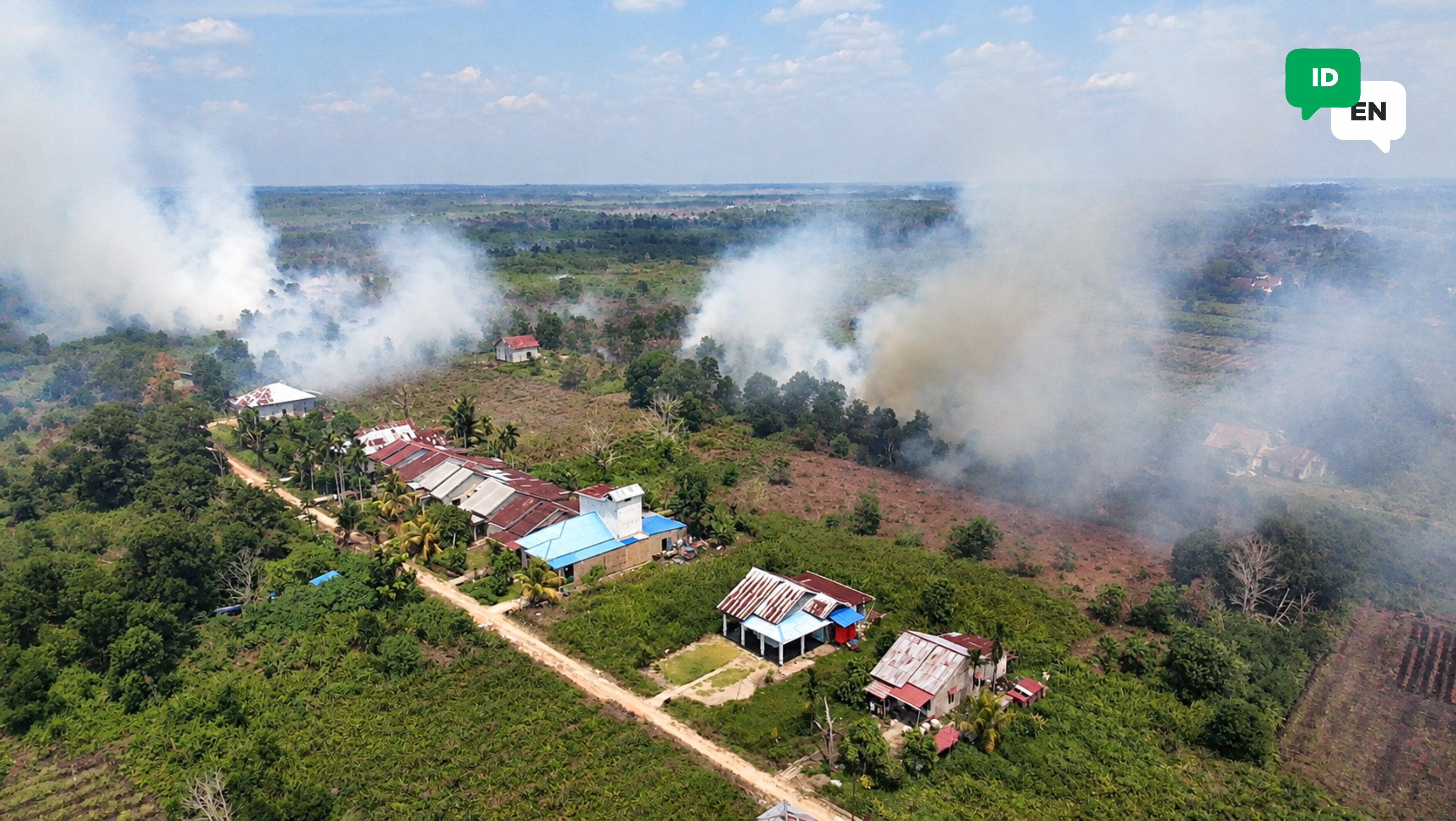
Jakarta, September 8, 2026 — Forest and land fires throughout 2026 have once again become a source of large-scale emissions. WALHI has calculated the emissions resulting from these fires. Estimated emissions from burned vegetation from January through early September 2026 reached approximately 31 million metric tons of CO2. These emissions are equivalent to nearly the entire annual greenhouse gas emissions of Cuba—a country with a population of about 11.3 million—covering all of its energy, transportation, industrial, and agricultural sectors for a full year.
Meanwhile, based on heat detection from Copernicus satellites, emissions from forest and land fires are significantly higher, reaching 65.18 Mt C—equivalent to approximately 239 million metric tons of CO2. This means that 239 million metric tons of CO2 is equivalent to Kazakhstan’s total annual fossil fuel emissions, encompassing coal-fired power plants, industry, transportation, and all of the country’s economic activities over a full year.
“The magnitude of these emissions highlights a serious contradiction in Indonesia’s climate commitments through the FOLU Net Sink 2030 initiative. The government aims for the forestry and other land-use (FOLU) sector to absorb more emissions than it releases by 2030. However, as forests, land, and peatlands continue to burn, carbon that should be stored is instead released back into the atmosphere,” said Patria Rizky Ananda, Climate and Global Issues Campaigner at WALHI.
Patria also added, “How can Indonesia achieve the FOLU Net Sink if, at the same time, tens to hundreds of millions of metric tons of CO2 continue to be released from forest and land fires? Every fire means that carbon that should be stored within the ecosystem is released back into the atmosphere. This is not merely a matter of fire management, but a matter of the credibility of Indonesia’s climate commitments.”
The 2030 FOLU Net Sink target is intended to be achieved through a number of interventions, including reducing emissions from deforestation and forest degradation, increasing carbon sequestration, and reducing emissions from fires and peat decomposition. However, the recurring forest and land fires indicate that one of the main emission sources in the FOLU sector has not yet been successfully controlled.
“In fact, the FOLU has essentially failed from the moment it was formulated. The logic behind FOLU—which still allocates large quotas for converting forests into business concessions—is directly linked to the ongoing forest and land fires. Referring to SiPongi+ data, for example, CO2 emissions from forest and land fires were recorded at 53,527,407 metric tons of CO2 in 2024, then increased to 56,204,535 metric tons of CO2 in 2025. This represents an increase of approximately 2.7 million metric tons of CO2 in one year. “This situation highlights a fundamental contradiction: the government is targeting increased carbon sequestration, yet has failed to stop carbon emissions from the very same ecosystems,” said Uli Arta Siagian, National Campaign Coordinator at WALHI.
For WALHI, forest and land fires must be prioritized as a key issue in Indonesia’s climate policy. The government must ensure that prevention measures are risk-based, particularly in peatland ecosystems and areas that have repeatedly experienced fires, while simultaneously ending management practices that make carbon sinks increasingly vulnerable to fires. Peatland protection and restoration must be central to the FOLU strategy, not merely addressed after fires have already occurred.
At the same time, the government must tighten oversight of concessions and enforce the law against corporations proven to have caused or allowed forest and land fires to occur. The integration of climate policy with land-use planning and permitting is also absolutely necessary to ensure that land-use policies do not result in emissions that contradict the FOLU Net Sink target. These efforts must go hand in hand with strengthening the role of indigenous peoples and local communities in protecting and restoring fire-prone ecosystems.
“The success of the FOLU Net Sink 2030 target should not be measured solely by how much carbon is claimed to have been sequestered, but also by how effectively the government is able to stop the continued release of carbon,” added Patria.
“The 2026 forest and peatland fires demonstrate that the work is not yet complete. As long as forests and peatlands continue to burn, millions of metric tons of emissions are still being released, and these sources of emissions are not stopped, the commitment to the FOLU Net Sink 2030 goal is questionable. Indonesia cannot claim to be on track toward a net sink while allowing carbon-storing ecosystems to continue serving as sources of emissions,” concluded Uli.
Wahana Lingkungan Hidup Indonesia
Jl. Tegal Parang Utara No. 14, Mampang Prapatan, South Jakarta
email:[email protected] | Instagram: @walhi.nasional | X: @walhi.nasional
TikTok: @walhi.nasional
Mobile: (+628115501980)