Press Release
Indonesian Forum for the Environment (WALHI)
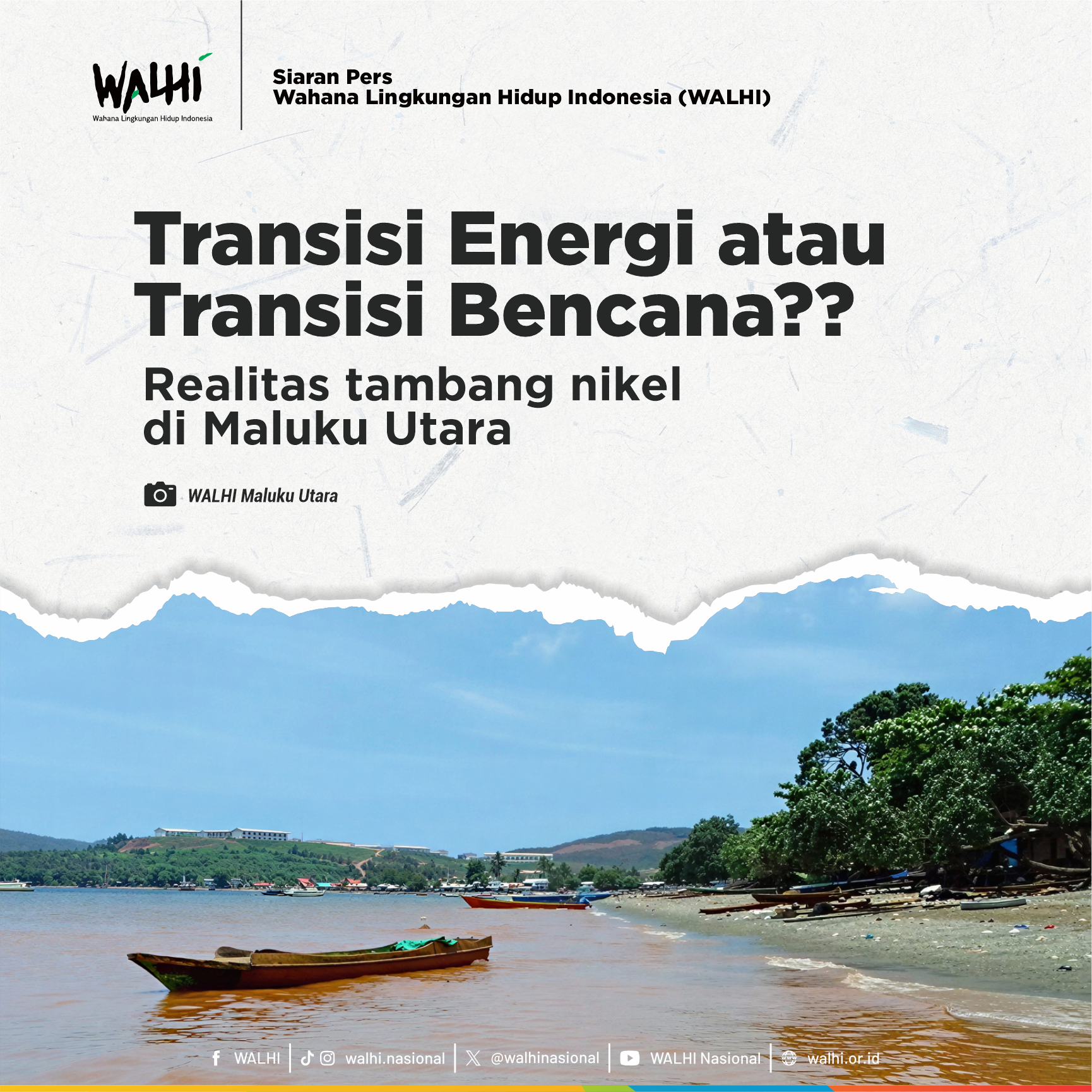
Jakarta, January 30, 2026 - Residents of Kawasi Village, together with Wahana Lingkungan Hidup Indonesia (WALHI) North Maluku, have highlighted the serious impacts of nickel mining on Obi Island, South Halmahera Regency, North Maluku. The presence of Harita Nickel has drastically altered the lives of the community, ranging from environmental damage, health threats, and disruptions to education, to social and economic pressures. Amid claims of energy transition and sustainable development, residents are instead facing the loss of their living spaces, intimidation, and criminalization when voicing their opposition.
Samsir Lawendi, a resident of Kawasi Village, emphasized that since the arrival of PT Harita Group, there has never been any collective community involvement; residents only learned of the company’s existence after it began operations.
He also revealed practices of land grabbing and the criminalization of residents who are defending their living space. “There are residents’ lands that they took without notifying anyone. … If residents protest, they are even criminalized, intimidated, or even imprisoned.” Someone was already imprisoned at that time; the verdict was final, and he has already served his sentence—Mr. Domingus Johannes, who defended his land that was forcibly taken by the company. To this day, that issue remains unresolved,” said Samsir.
In addition to land seizures, the people of Kawasi Village are now also facing relocation plans. Samsir stated that the residents have rejected the relocation because it threatens their existence as an indigenous community. “What the government there is saying is that there is already a local regulation or a governor’s regulation along with its implementing guidelines; we hope these can be revoked because that land is our customary land, and we live in harmony with one another as fellow residents,” he said.
Nurhayati Jumadi, a resident of Kawasi Village, highlighted that the relocation is being carried out systematically through the education sector. “The policy to relocate the village begins with the education system itself. For example, they employ the tactic of moving the schools first before relocating the community. That’s the reality—back then, high schools and junior high schools were relocated, and now even elementary school students have been moved. ... So I consider this a tactic to get the people of Kawasi to move to the Ecovillage faster,” she said.
Nurhayati also revealed changes in water quality that residents have noticed since mining activities began. “There have been changes in the water that we’ve noticed—our water used to taste sweet. For example, when making tea, we didn’t need much sugar, but now the taste has changed; it’s salty. … If this water isn’t boiled properly, we’ll get stomachaches.” That’s already happened; we’ve felt it. Starting in 2021, there were changes in the water—every time we boiled it, there were these soap-like bubbles,” she said.
Meanwhile, the impact of marine pollution is felt directly by women fishermen. Sarbanun Lewer, a resident of Kawasi, described the drastic changes in the condition of the sea, which is their source of livelihood. “Back then, when my husband and I went out to set our nets, we’d earn 2–3 million in just 2–3 hours. But now, even if we go out for a whole day, we might not even catch enough fish to eat. ... I’ve lost all hope ... I don’t go out to fish anymore because our ocean isn’t the same as it used to be. Our ocean is now murky and yellow, and our nets aren’t white anymore. As soon as we set them down—let alone an hour—even after just 15 minutes, when we pull them up, they’re already yellow; they’re no longer nets, but just mud,” she said.
Faisal Ratuela, Executive Director of WALHI North Maluku, emphasized that Obi Island is in a highly vulnerable condition due to the massive number of mining permits and the rapid pace of extraction. “We do not consider an area over 2,000 km² to be a category of island that will be safe because Obi Island is 2,400 (km²) or so, but the pace of extraction is such that there are 21 mining permits covering nearly 70% of Obi’s territory, and the residents there will certainly be displaced,” he asserted.
In closing, Faisal assessed that the issues on Obi Island reveal a fundamental mistake by the state in its understanding of Indonesia, particularly North Maluku as an archipelagic region. Land and sea form a single living space, especially on small islands with limited carrying capacity and environmental capacity. The release of forest areas and industrial expansion without considering buffer zones and watersheds (DAS) has triggered disasters such as floods and landslides, pollution, and threatens the community’s food sources, both on land and at sea. These conditions demonstrate that the nickel industry on Obi Island not only impacts the environment but also directly erodes the food security and livelihoods of communities directly affected by Harita Group’s operations.
For more information:
Wahana Lingkungan Hidup Indonesia,
Jl. Tegal Parang Utara No. 14, Mampang Prapatan, South Jakarta
email: [email protected] | Instagram: @walhi.nasional | X: @walhi.nasional
TikTok: @walhi.nasional. Mobile: (+628115501980)