From a Small Island to the Global Stage: Advocating for Climate Justice from Pari Island
21st Asia Media Summit | Voices from the Waves: Small Islands, Big Stories
By: Patria Rizky Ananda, Climate and Global Issues Campaigner at WALHI
The climate crisis is not an issue that recognizes national borders. Emissions produced by large corporations in one region can bring disaster to communities living thousands of kilometers away. Its impacts cross geographical, political, and economic boundaries. Therefore, the climate crisis must be understood as a transboundary issue that requires global solidarity and a commitment to the groups most affected.
In various parts of the world, communities living on small islands are among the most vulnerable to the impacts of the climate crisis. Rising sea levels, coastal erosion, extreme weather, clean water crises, and the destruction of their living spaces and livelihoods are real threats they face every day. Yet, communities on small islands are not the ones responsible for the highest carbon emissions.
The Experience from Pari Island
The residents of Pari Island have also experienced this situation. In 2021, they experienced tidal flooding at least ten times, with four occurrences during the east wind season in July-August and six during the west wind season in November-December. The tidal flooding that occurred at the end of the year was the worst experienced by residents, with water levels reaching 50-150 cm.
As a result of the flooding, the community lost their income from tourism because many tourists canceled their visits. Tourism is one of the main sources of income for residents, through the rental of accommodations, diving equipment, and boats, as well as entrance fees to tourist sites and sales at local residents’ small shops. Since the tidal flooding that occurred throughout 2021, tourists have been flocking back in February 2022. This means that residents lost their income for approximately 3-4 months.
In addition, they are unable to access clean water from their wells because seawater has seeped in, making the water salty. As a result, residents have to spend more money to access clean water through water purification facilities. They also have to clean their homes of flood debris, which has forced them to stop going out to sea for 2-3 days.
Since the tidal flooding that occurred in 2021, residents have been experiencing increasingly frequent tidal flooding and extreme weather events. For the people of Pari Island, the climate crisis is no longer a future threat, but a reality that has damaged their living environment and had a devastating impact on them in recent years. This reality certainly hasn’t left the people of Pari Island sitting idly by; instead, they are fighting to demand their right to safety and to a good and healthy environment. They recognize that climate justice is also part of the right to a good and healthy environment. Therefore, holding accountable for those who have long profited at the expense of their rights is an action that must be taken.
In 2023, the residents of Pari Island took a historic step by filing a lawsuit against Holcim, one of the world’s top contributors to carbon emissions. This lawsuit has become a symbol of grassroots efforts to hold corporations accountable for the tangible impacts of the climate crisis they are experiencing. It also demonstrates that affected communities are not standing idly by in the face of global climate injustice.
Voices from Small Islands at the 21st Asia Media Summit
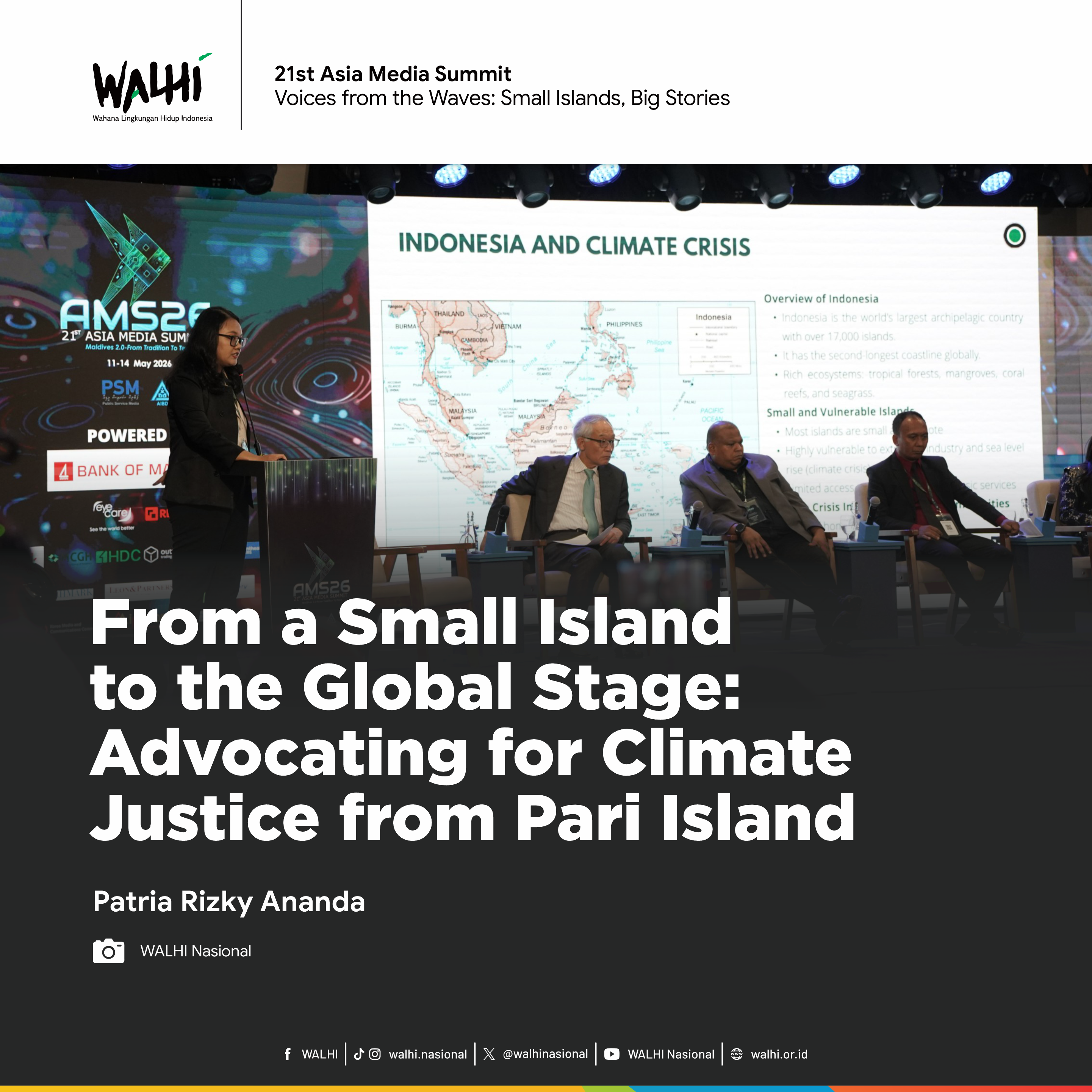
The issue of small islands was a key focus at the 21st Asia Media Summit during a plenary session titled “Voices from the Waves: Small Islands, Big Stories.” This session highlighted the importance of the media’s role in amplifying the voices of local communities, particularly small island communities that are often overlooked during global crises. The Asia Media Summit is an annual forum organized by the Asia-Pasific Institute for Broadcasting Development that brings together approximately 350 participants, including media professionals, broadcasters, academics, and government officials from the Asia-Pacific region.
At the forum, WALHI highlighted the climate crisis in Indonesia, particularly the impacts faced by communities on small islands. WALHI also highlighted the struggle of the residents of Pari Island, who continue to demand climate justice through climate lawsuits against companies contributing to the climate crisis.
WALHI’s Call to Media Colleagues
The forum is important because the media plays a strategic role in raising public awareness across national borders. The media can help bring the experiences of the people of Pari Island to the global stage, build international public solidarity, and apply reputational pressure on high-emission corporations that have long contributed to the climate crisis.
Furthermore, media coverage can also highlight that the climate crisis is not merely an environmental issue, but a matter of justice. When communities on small islands lose their living space due to rising sea levels, while corporate profits continue to rise, there is an inequality that must be addressed and held accountable.
In this regard, WALHI calls on our media partners to continue being part of the grassroots movement by amplifying voices from the local level to the broader public sphere. The media must prioritize climate justice issues—particularly those faced by communities on small islands—as a key focus on their journalistic and broadcasting work.
The voices of small islands must not be silenced. For it is from these small islands that the world can clearly see how the climate crisis is having a tangible impact, and why the fight for climate justice must be a shared struggle that transcends national borders.