Joint Press Release
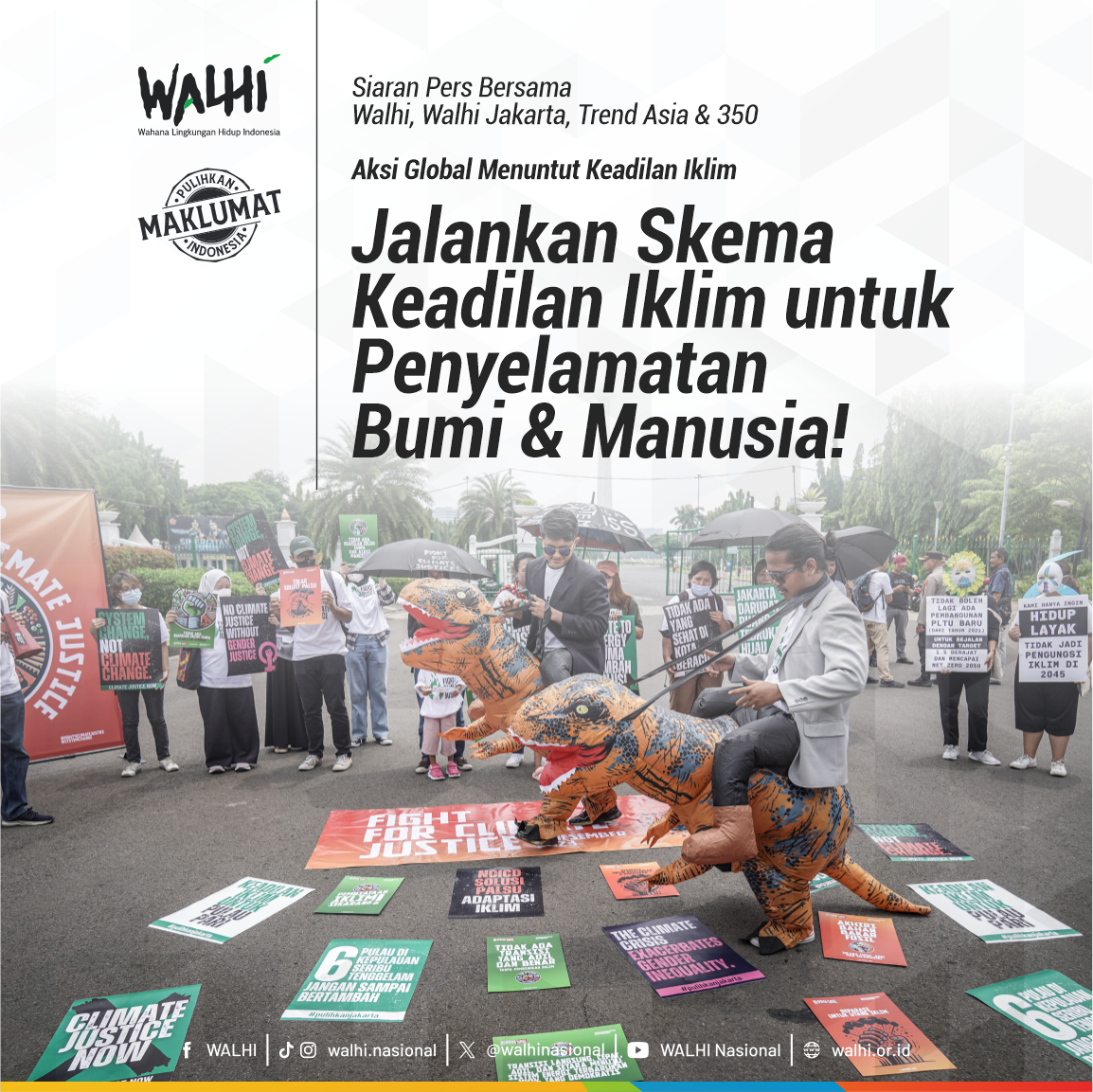
Global Action Demanding Climate Justice
Jakarta, December 9, 2023 -- The UNFCCC COP 28 is currently taking place in Dubai from November 30–December 12, 2023. The COP28 conference, taking place in a fossil fuel-producing country, has yet to address the urgency of the climate crisis in its negotiations. Although the IPCC report released in April 2023 highlighted the urgency of the climate crisis, the COP 28 venue is still being used as a “business” forum for countries, corporations, and financial institutions.
People and communities around the world are suffering terribly due to various crises stemming from long-standing injustice, inequality, and oppression. The climate crisis is causing extreme weather events and disrupting ecosystems worldwide. People who have already suffered from poverty, discrimination, exploitation, and oppression are the most vulnerable to this crisis and have limited access to the resources needed to cope with its impacts.
In Indonesia alone, the number of people whose lives and livelihoods are at risk continues to grow. In coastal areas and on small islands, for example, a study by Kompas Research and Development (2023) states that by 2030, 926,492 fishermen (and farmers) will leave their current jobs due to the climate crisis and climate-related projects. This figure represents a massive loss for Indonesia as a maritime nation and the world’s largest archipelago. Climate-related disasters are also on the rise, resulting in the loss of lives, homes, assets and property, livelihoods, and more.
Unfortunately, in climate policy and action, meaningful recognition and inclusion of women, people with disabilities, indigenous communities, and other vulnerable groups remain minimal—if not virtually nonexistent. Climate solution schemes do not hold industrialized nations and corporations—the primary contributors to emissions—accountable for their responsibilities and obligations; on the contrary, existing schemes actually facilitate industrialized nations, corporations, and international financial institutions to profit in the name of the “climate crisis”.”
False climate solutions that fail to address the root causes of the problem are particularly evident in mitigation schemes that prioritize investment over people’s safety and ecological sustainability. Carbon trading and energy transition schemes are two examples that sideline the needs of people affected by the climate crisis. This includes climate financing schemes; although COP28 launched the Loss and Damage Fund with an initial commitment of USD 430 million (Rp. 6.67 trillion), there remain many questions regarding the sources of funding as well as the mechanisms for its distribution and management. Meanwhile, climate finance schemes funded by debt are also substantial; for example, 99 percent of funding for the energy transition comes from debt.
For this reason, the global actions taking place in various countries, including Indonesia, provide an opportunity to once again demand climate justice and systemic change, as well as to call for the concrete solutions needed by the poor in particular. COP 28 should serve as an opportunity to launch a counteroffensive by exposing the failures and maneuvers of governments, corporations, and elites in their efforts to evade their responsibilities and obligations. (*)
Further information
Parid Ridwanuddin, WALHI National Executive, 081237454623
Muhammad Aminullah, WALHI Jakarta Regional Executive, 085695523194
Ginajar, 350 Campaigner, 085156568359
Ashov Birry, Trend Asia, 08111757246
Note: For a more complete set of photos, please download them from the following link: https://drive.google.com/drive/folders/1Qb7MF_0JCakMyqB2ToNsPW3OPlwInQk-