LEMBAR FAKTA
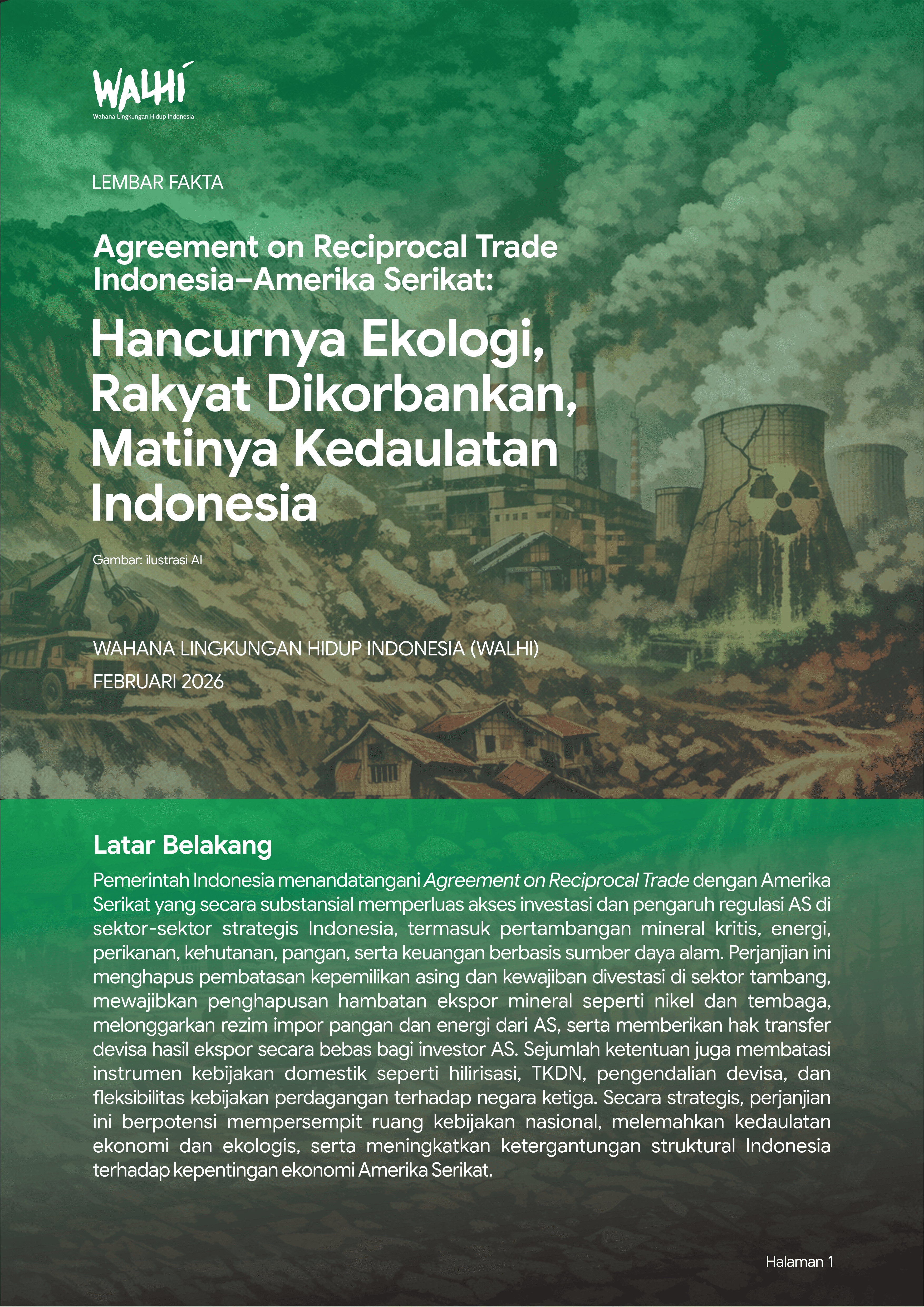
Agreement on Reciprocal Trade Indonesia–Amerika Serikat: Hancurnya Ekologi, Rakyat Dikorbankan, Matinya Kedaulatan Indonesia
Pemerintah Indonesia menandatangani Agreement on Reciprocal Trade dengan Amerika Serikat yang secara substansial memperluas akses investasi dan pengaruh regulasi AS di sektor-sektor strategis Indonesia, termasuk pertambangan mineral kritis, energi, perikanan, kehutanan, pangan, serta keuangan berbasis sumber daya alam. Perjanjian ini menghapus pembatasan kepemilikan asing dan kewajiban divestasi di sektor tambang, mewajibkan penghapusan hambatan ekspor mineral seperti nikel dan tembaga, melonggarkan rezim impor pangan dan energi dari AS, serta memberikan hak transfer devisa hasil ekspor secara bebas bagi investor AS. Sejumlah ketentuan juga membatasi instrumen kebijakan domestik seperti hilirisasi, TKDN, pengendalian devisa, dan fleksibilitas kebijakan perdagangan terhadap negara ketiga. Secara strategis, perjanjian ini berpotensi mempersempit ruang kebijakan nasional, melemahkan kedaulatan ekonomi dan ekologis, serta meningkatkan ketergantungan struktural Indonesia terhadap kepentingan ekonomi Amerika Serikat.
Secara ekologis, perjanjian ini berpotensi mempercepat kerusakan lingkungan yang sudah berada dalam tekanan berat akibat praktik ekstraktif di Indonesia. Data WALHI menunjukkan bahwa luas konsesi pertambangan nikel di Indonesia mencapai lebih dari 1,03 juta hektare, di mana lebih dari 765 ribu hektare berada di dalam kawasan hutan, menandakan ekspansi tambang terus menggerus tutupan hutan alam yang berfungsi sebagai penyerap karbon dan habitat utama keanekaragaman hayati (WALHI, 2023). Lebih jauh, WALHI memperkirakan sekitar 26,68 juta hektare hutan—sekitar seperempat tutupan hutan Indonesia—berada di bawah berbagai izin industri ekstraktif: kehutanan, pertambangan dan perkebunan. Jika seluruh izin tersebut terealisasi, potensi emisi yang dilepaskan dapat melampaui 9 miliar ton CO₂e, setara dengan akumulasi emisi sektor energi nasional selama sekitar dua dekade terakhir (WALHI, 2025). Konsentrasi penguasaan lahan juga akan semakin tajam.
Selengkapnya, silahkan unduh dokumen berikut:
LEMBAR FAKTA (Bahasa)
----- ----- -----
FACT SHEET
Agreement on Reciprocal Trade between Indonesia and the United States: Ecological Destruction, Sacrificing the People, the Death of Indonesian Sovereignty
The Indonesian government signed an Agreement on Reciprocal Trade with the United States that substantially expands US investment access and regulatory influence in Indonesia's strategic sectors, including critical mineral mining, energy, fisheries, forestry, food, and natural resource-based finance. This agreement removes foreign ownership restrictions and divestment obligations in the mining sector, requires the removal of barriers to the export of minerals such as nickel and copper, relaxes the regime for food and energy imports from the US, and grants US investors the right to freely transfer export proceeds. A number of provisions also limit domestic policy instruments such as downstreaming, local content requirements, foreign exchange controls, and trade policy flexibility towards third countries. Strategically, this agreement has the potential to narrow the scope of national policy, weaken economic and ecological sovereignty, and increase Indonesia's structural dependence on US economic interests.
Ecologically, this agreement has the potential to accelerate environmental damage that is already under severe pressure due to extractive practices in Indonesia. WALHI data shows that the area of nickel mining concessions in Indonesia reaches more than 1.03 million hectares, of which more than 765 thousand hectares are located within forest areas, indicating that mining expansion continues to erode natural forest cover that functions as a carbon sink and a major habitat for biodiversity (WALHI, 2023). Furthermore, WALHI estimates that around 26.68 million hectares of forest—about a quarter of Indonesia's forest cover—is under various extractive industry permits: forestry, mining, and plantations. If all of these permits are realized, the potential emissions released could exceed 9 billion tons of CO₂e, equivalent to the accumulated emissions of the national energy sector over the past two decades (WALHI, 2025). Land ownership concentration will also become more acute.
Click to download:
FACT SHEET (English)