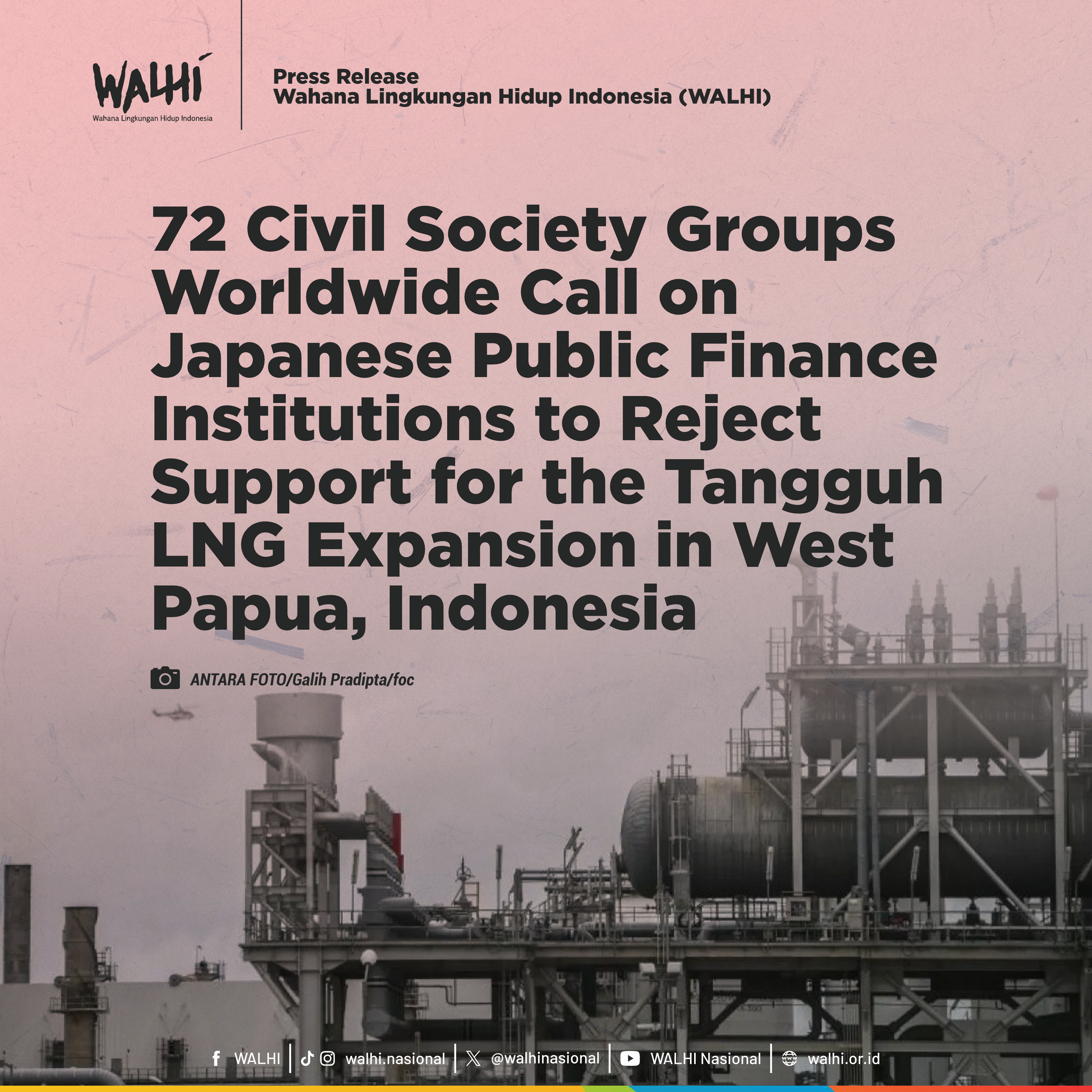
TOKYO and JAKARTA – On February 24, 2026, 72 civil society organizations from around the world submitted a petition to the Ministry of Finance (MoF), the Ministry of Economy, Trade and Industry (METI), the Japan Bank for International Cooperation (JBIC; 100% state-owned), and the Nippon Export and Investment Insurance (NEXI; 100% state-owned), urging them to reject to provide support for any expansion plans related to the Tangguh LNG (Liquefied Natural Gas) project (Tangguh LNG) in West Papua Province, Indonesia. The letter emphasized that such expansion would further accelerate the climate crisis, threaten the environment and human rights of local communities, and delay Indonesia’s just energy transition.
In the letter, the civil society groups points out the following six “Reasons Why JBIC and NEXI Must Not Support the Tangguh LNG Expansion Plans”:
- Environmental, Social, and Human Rights Impacts on Indigenous Peoples Since the Early Phase of the Project
- Suppression of Civil Society Space in Papua
- Inconsistent with the Paris Agreement’s 1.5°C Goal
- Failure to Comply with G7 Commitment
- CCUS (Carbon capture, utilization and storage) is a False Solution
- Prolonged Fossil Fuel Dependence and Delayed Energy Transition in Indonesia
Tangguh LNG—Indonesia's largest gas production hub— is a project pursued by a consortium led by BP plc as operator and largest investor (40.22%) under a production sharing contract extending until the end of 2055. Approximately 46% of the consortium’s interests are held by six Japanese companies (Mitsubishi Corporation, INPEX CORPORATION, ENEOS Xplora Inc., LNG JAPAN CORPORATION (a joint-subsidiary of Sojitz Corporation and Sumitomo Corporation), MITSUI & CO., LTD.) and Japan Organization for Metals and Energy Security (JOGMEC). JBIC and NEXI have also provided support to the Tangguh LNG twice since the 2000s. Kansai Electric Power Co., Inc. also purchases gas from this project.
The expansion plans currently being promoted include the new development of the Ubadari Gas Field and the CCUS for EGR (Enhanced Gas Recovery) at the currently producing Vorwata gas field.
Uli Arta Siagian, Coordinator Campaigner of National Executive of Wahana Lingkungan Hidup Indonesia (WALHI/Friends of the Earth Indonesia) emphasized, “To prevent disasters like the one that struck Sumatra late last year from recurring in the future, these Tangguh LNG expansion plans must be halted, and that the transition to clean, sustainable renewable energy based on community needs must proceed without delay.”
Maikel Peuki, Executive director of WALHI Papua stated, “We, who have documented and advocated for indigenous peoples in Papua, observe that today Papua faces enormous challenges in overcoming the onslaught of various extractive investment threats that have been given the red carpet treatment by the state. This red carpet treatment or facilitation can be seen in the passing of the Omnibus Law, which has attracted a lot of public attention in Indonesia. During the passage of the Omnibus Law, we witnessed several protests brought before the government in Senayan, Jakarta. These protests were largely opposed by young Indonesians, as the government recklessly gave opportunities to investors in the name of economic equality.
In recent years, we have seen the clear deforestation of natural forests in the name of economic prosperity without considering ecological aspects, such as the mangrove forest in Bintuni Bay, which covers an area of 225,367 hectares or 52 percent of the total mangrove forest in West Papua. Now we will see the condition of the Bintuni Bay mangrove forest, especially in the Tanah Merah coastal area, which has suffered severe damage.”
Novita Indri, energy campaigner of Trend Asia pointed out, “False solutions like CCUS will not significantly cut emissions, hence JBIC and NEXI should reconsider not funding fossil fuel projects like Tangguh. Instead, they will only risk becoming stranded assets and suffering losses as a result of the trend shift to renewable energy, which is more affordable, reliable, and sustainable.”
Hozue Hatae, finance campaigner of Friends of the Earth Japan stated, “Given the deep involvement of Japanese public and private entities in the implementation of the Tangguh LNG, the roles and responsibilities of Japan's public financial institutions in determining the feasibility of the expansion plan, are extremely significant. Overseas fossil fuel development projects supported by JBIC and NEXI to date have caused various harms in many regions and have faced strong international criticism. Both JBIC and NEXI should not cause further severe harm to local communities and ecologies, nor undermine global efforts toward the Paris Agreement's 1.5°C goal. They therefore must not provide support for the Tangguh LNG expansion plans.”
For more details, please refer to the petition (PDF):
https://foejapan.org/wpcms/wp-content/uploads/2026/02/20260224_e_re.pdf
Contact:
Uli Arta Siagian, National Executive of WALHI: [email protected]
Novita Indri, Trend Asia: [email protected]
Hozue Hatae, FoE Japan: [email protected]